






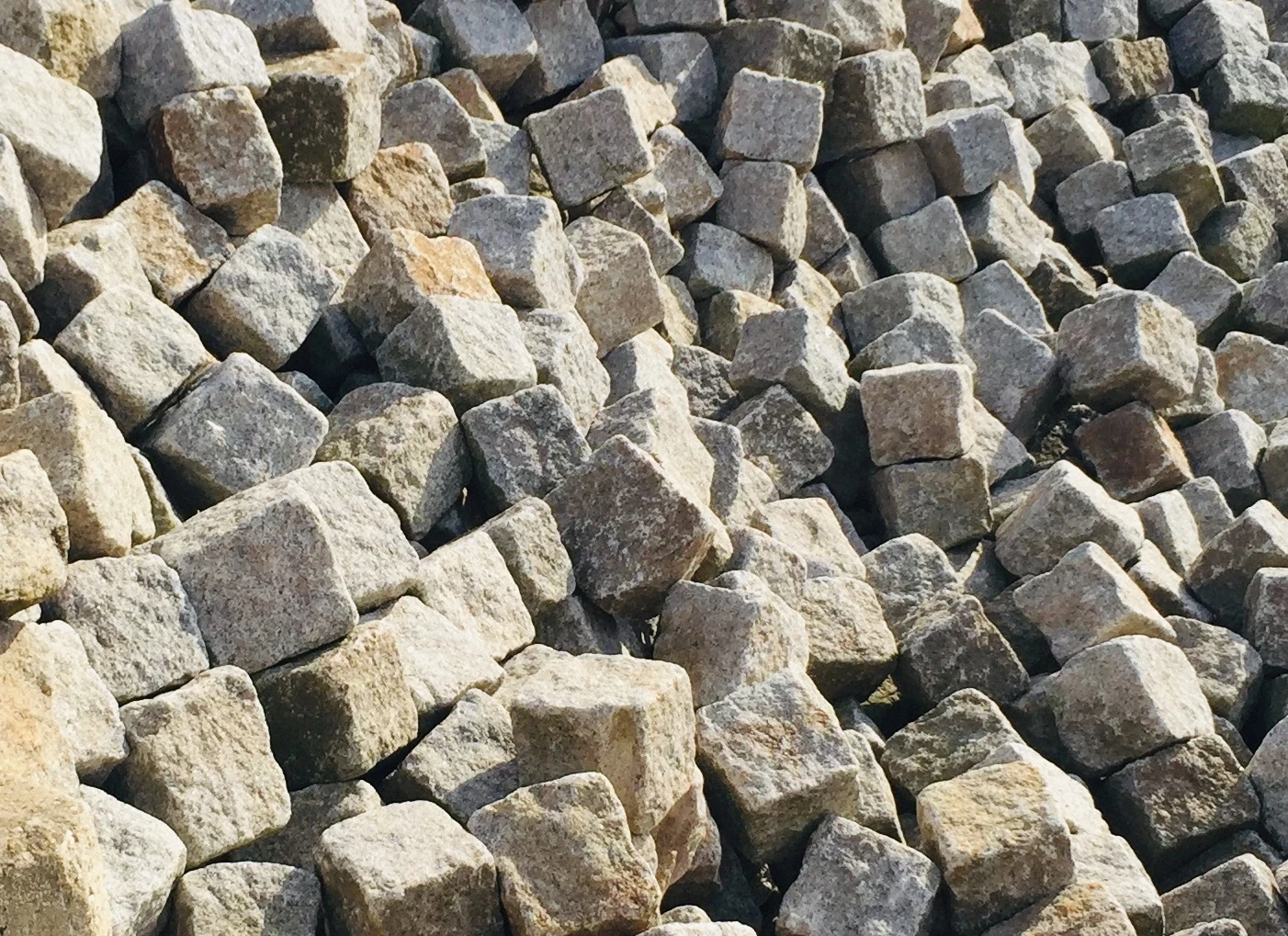
Paving joints · Product selection · Practical guide
Do you want to refill narrow paving joints in your garden, at your front door, or in your driveway? vdw VarioSand Basalt Grey 25 kg is a ready-to-use special jointing sand for suitable concrete paving surfaces. This guide will help you check its suitability, determine the material requirements, and prepare for application – including important considerations before purchasing.
The most important thing to note: Consistent joint widths of 2–4 mm, a minimum filling depth of 40 mm, and a stable, load-bearing, and permanently permeable substrate are crucial. For areas subject to vehicular traffic, the joint must be filled to the full height of the stone. This product is not intended for use with paving slabs. [2] [3]
What is vdw VarioSand Basalt Grey?
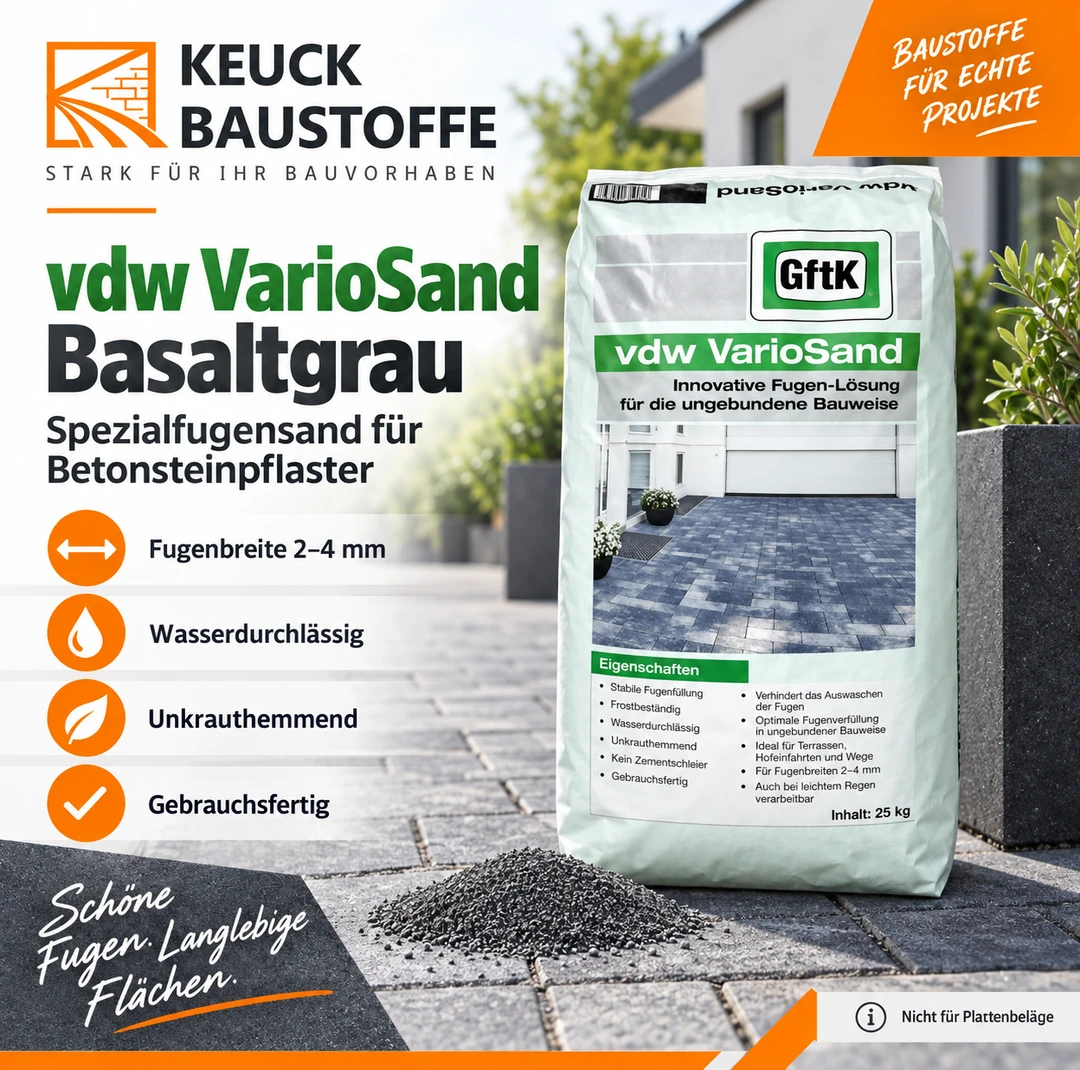
vdw VarioSand is a special cohesive jointing sand for unbound paving. It is applied dry and compacted; water then activates the binder. Pre-mixing is not required. The color variant of this product is called Basalt Grey , and the container holds 25 kg . [1] [2]
Three properties are particularly helpful to consider when making your selection: water-permeable describes water passage, not a seal. Weed-inhibiting does not guarantee completely weed-free joints. Ready-to-use means that no mixing is required before sweeping – however, careful preparation, compaction, and post-treatment are still necessary.
- Fine-sand finish for suitable, narrow paving joints.
- Binders support stable joint filling and reduce sanding.
- Water-permeable and weed-inhibiting properties.
- Dust-free processing; however, always observe the relevant safety instructions.
Features and classification according to the manufacturer's information; no independent product test. [2] [3]
| feature | Specification and condition |
|---|---|
| Product / Colour | vdw VarioSand / Basaltgrau |
| Container | 25 kg net contents in the bag; Manufacturer's website: PP bag |
| Keuck article number | 14031 |
| Fugenbreite | Continuous minimum 2 mm, maximum 4 mm |
| Filling depth | At least 40 mm; full stone height when driven over. |
| Temperature during installation | 8–30 °C for outside air and object |
| Subsoil | Stable, load-bearing and permanently water-permeable |
| Need is Liter | Approximately 1.5–1.7 kg per liter of joint space in the compacted state |

The properties of vdw VarioSand at a glance. Illustrative representation; please refer to the product and application instructions in the text. Enlarge graphic .
For which applications is the product suitable?
Suitable concrete block paving surfaces include garden and walkways, courtyards and entrances, as well as appropriately constructed driveways. The manufacturer specifies private and public paved areas under normal traffic loads. However, the designation "driveway" or "garden path" alone is not sufficient for the decision: the surface, joint space, and substructure must be compatible. [1] [2]
Therefore, don't just inspect an existing surface from above. Also note its intended use and the actual available fill depth. A surface that appears clean doesn't tell you whether the joints can be completely filled and whether water can drain away permanently from the structure.
For trafficked areas: The minimum depth for general use does not replace the requirement of "full stone height". Clarify the traffic load and the structure before ordering based solely on the square meterage. [3]
What is vdw VarioSand not suitable for?
The technical data sheet excludes slab coverings and specifies edge lengths exceeding 30 cm. A narrow joint does not automatically make a large-format slab a suitable paving stone. Nor can approval for a specific covering be derived from an application image. [3]
Prolonged dampness can damage the product. It is also not resistant to pressure washers or sweepers. Therefore, consider how the area will be drained and subsequently cleaned before purchasing. If suitability is unclear, it is more advisable to consult a technical advisor than to test the product on the entire area. [2] [3]
What conditions must be met before processing?
Before starting work, compile a brief project list: surface type, intended use, joint width and depth, area size, substructure, and weather conditions. This information will link product selection to the actual work process.
- Check joints: The required dimensions must be available throughout; a surface measurement alone is not sufficient.
- Start dry: The stone surface and joint edges must be completely dry. Moisture activates the binding agent.
- Plan for the weather: In addition to an outside and object temperature of 8–30 °C, at least two frost-free days are required after installation.
- Test before the main area: First assess the material on an inconspicuous, suitable partial area.
Binding requirements and test area information: [2] , [3] .
Prepare a broom, suitable compaction equipment, and a garden hose with an adjustable nozzle. Select the equipment and protective mat appropriate for the surface. Also plan for edges that cannot be reached with the slab. This will prevent interruptions at a point where cleaning and watering need to be coordinated.
Processing step by step
The following sequence outlines the steps for your preparation. It does not replace the current information sheet or the instructions on the container. Do not work on the main surface until the coating and test area have been assessed. [3]
1. Clean and allow to dry completely.
Remove any residue. Begin only when the surface and joint edges are dry. Unlike some grouts, the surface is not pre-wetted before application for this method.
2. Sweep the material in dry
Distribute the VarioSand and fill the joints. Ensure that edges and transitions are completely filled, not just that they appear uniform from above.
3. Compact and refill
Sweep the surface and compact it with suitable equipment. The instructions specify a small vibrating plate compactor weighing approximately 60–80 kg with a protective mat for the jointing material; a rubber mallet can also be used for small areas. Repeat the refilling and compaction process until the required height is reached. The material should no longer give way when tested with a finger.
4. Check fill level and clean stone surface
Fill to a maximum of 2 mm below the top edge of the stone. Then remove all material residue with a soft, clean, dry broom and expose the chamfers. This cleaning must be done before water activation.
5. Activate with a gentle stream of water.
Water small sections starting from the deepest point. Repeat the process according to the instructions until the entire depth of the soil is thoroughly moistened. Avoid flushing, foaming, flooding, and puddles. The section must not be allowed to dry out during watering.
6. Check for moisture penetration
Carefully lift some grout in several places, for example with a spatula, and check for complete moisture penetration. A wet surface alone does not necessarily indicate sufficient water activation at depth.
7. Protect, allow to dry and release for use
Keep the area clear initially and observe the following time requirements. Complete drying is essential for the coating to set; a permanently applied cover is not recommended in dry weather.
Work sequence according to the manufacturer's website and information sheet, in particular installation, cleaning and binder activation. [2] [3]
When will the area be accessible again, either on foot or by vehicle?
| Use / Protection | Manufacturer's specifications |
|---|---|
| Rain protection | 3 hours; extend drying time at low temperatures or with delayed drying |
| Accessible | After 3 hours |
| Passable | After about 3 days |
| Final release | After 5 days |
These times are not independent of the weather. Cool, damp conditions and dew can delay drying. Extend the protection and closure times accordingly. Remove the rain protection after the required protection time; in dry weather, the joint should be allowed to dry completely. [3]

Why a test area is useful
The manufacturer points out the possibility of hazing or discoloration. Particularly rough or open-pored surfaces can make residue-free cleaning difficult. A general statement "without hazing" would therefore be inaccurate. [3]
Apply the test area before working on the main area, even though this instruction is explained after the work overview. Assess the result, including cleaning and drying. A screen display does not replace a binding color sample on your own surface.
Consumption and quantity planning: How far will 25 kg go?
The material requirement depends on the joint space, not just the paved area. Record the stone format, laying pattern, free joint width, and filling depth. The information sheet provides a guideline of approximately 1.5–1.7 kg per liter of joint space and approximately 3–4 kg/m² for a 40 mm joint depth for concrete block paving. [3]
Material requirement = Area × suitable consumption per m²
Number of bags = Material requirement ÷ 25 kg
Round the order quantity up to whole bags.
Example calculation for a 20 m² area
For this example, we assume a surface area of 20 m², a filling depth of 40 mm, and a corresponding consumption of 3.5 kg/m². This consumption figure is a calculated assumption within the guideline range , not an individually determined value for your specific surface.
| Assumed area | 20 m² |
|---|---|
| Consumption (assumed) | 3.5 kg/m² at a filling depth of 40 mm |
| Material requirements | 20 × 3,5 = 70 kg |
| Number of bags | 70 ÷ 25 = 2.8 bags |
| order quantity | 3 bags = 75 kg |
The remaining 5 kg result from the rounding of the container. This is not a manufacturer's recommendation for a reserve. Decide whether to add more based on joints, edges, losses, and your workflow.
Based on a density of 3–4 kg/m² , a 25 kg bag theoretically covers approximately 6.25–8.33 m² . This is not a fixed coverage figure. Especially in areas subject to vehicular traffic, the required full stone height should not be replaced by the 40 mm assumption. Plan based on the actual joint volumand.

Who would benefit from this product?
This guide is aimed at private homeowners as well as garden and landscape designers who want to grout suitable concrete paving stones. To help you decide, we recommend noting not only the desired color but also the results of the suitability test. This will allow you to place a targeted order or ask a technical question.
If the surface, joints, and structure are suitable, the ready-to-use delivery form is practical. If any of these prerequisites are missing, the design or product selection should be clarified first – not just the quantity.
Avoid common mistakes and maintain paving joints
| Mistake | A better approach |
|---|---|
| Start on damp stones | Allow the surface and joint edges to dry completely. |
| Just fill in, do not compact sufficiently | Repeat refilling and compaction; check the fill level. |
| Soak the remaining liquid on the stones. | Before activation, sweep away all residue and expose the chamfers. |
| Only wet the top surface of the joint. | Check for moisture penetration throughout the entire filling depth. |
| Understanding time guidelines as a weather guarantee | Consider drying, temperature and humidity when releasing the product. |
| Clean later with a pressure washer or sweeper. | Coordinate a suitable, gentle care procedure with the manufacturer or specialist company. |
The control points summarize the processing and maintenance limits. [2] [3]
Keep the product documentation for future reference. This is especially helpful if someone else will be cleaning the product. Store unused material in a dry, frost-free place and check the information on the packaging; the manufacturer's instructions are definitive for the specific storage duration.
Frequently asked questions about vdw VarioSand Basalt Grey
Is the jointing sand suitable for patio slabs?
No. The information sheet excludes paving slabs. The decisive factor is the type of surface, not the designation of the area as a terrace. [3]
Can I use this to grout a driveway?
This may be possible with suitable concrete block paving, normal traffic load, and appropriate construction. For areas subject to vehicular traffic, the infill must extend to the full height of the blocks. This does not automatically mean that any driveway is permitted. [2]
Does VarioSand need to be mixed before processing?
No. The material is applied dry. Water is only used for activation after compaction and thorough surface cleaning. [2]
What does "weed-inhibiting" mean?
This is a product characteristic, not a guarantee of permanently weed-free or maintenance-free areas. Therefore, avoid choosing a product solely based on the goal of "no maintenance required."
Why isn't there a fixed square meter measurement per bag?
Because the available joint space varies depending on the covering material. The calculation above is an assumption; use appropriate dimensions for your project instead of a general area yield.
Is the area passable after three hours?
No. Three hours refers to accessibility under the specified conditions. Accessibility, drivability, and final traffic clearance are separate stages; refer to the post-treatment table. [3]
Can I do without a test area?
The manufacturer explicitly recommends it. Especially on unknown or sensitive surfaces, the result should be assessed before applying it to the main area. [2]
Conclusion: Check the joint first, then order the appropriate size.
vdw VarioSand Basalt Grey is an option for creating suitable, narrow joints in concrete paving stones. A well-planned order combines the desired color with verified joint dimensions, appropriate drainage, and a transparent material requirement. Use the work sequence as preparation and the current manufacturer's instructions for execution.
vdw VarioSand Basalt Grey 25 kg at Keuck
Please check the available versions and current ordering options on the product page.
You can find more products for your project in the Keuck garden range . The shared shop category does not automatically guarantee the technical approval of any product combination.